Why Lighting Should Be Considered Early in the Kitchen Design Process
You can’t simply add lighting later on wherever it’s needed. Wiring, switches, dimmers, and outlets must be in place before tiling and plastering. This applies to new construction as well as when you’re renovating your kitchen.
At Häcker, there’s a second reason: Many lights are integrated directly into the furniture—in crown molding, shelves, glass cabinets, and pull-out drawers. Whether you control them later via a light switch, a remote control, or your smart home system also depends on the outlet layout in the room. That’s why lighting design belongs at the same planning table as furniture design. Our guide to kitchen planning shows how lighting fits into the overall process.
The Three Lighting Levels in the Kitchen
A good lighting design consists of several complementary layers: general lighting for the room, task lighting for work surfaces, and accent lighting to set the mood. Plan them individually and make sure they can be switched on and off separately.
General Lighting: Bright Throughout the Room
General lighting provides orientation and well-lit pathways. According to licht.de, the industry initiative of the lighting sector, a single fixture in the center of the ceiling is not sufficient for this purpose. It’s better to have at least two fixtures or several downlights, distributed across the ceiling and placed close to walls and windows.
Alternatives include lighting systems such as cable and rod systems or track systems with multiple adjustable spotlights. If there is only one ceiling outlet in the center of the room, cable and track systems direct the light where it’s needed. In an industrial-style kitchen, track systems also serve as a design element. For safety reasons, licht.de specifies a minimum illuminance of 500 lux for the room and recommends general lighting that can be dimmed.
Task Lighting: The Most Important Light When Cooking
On the countertop, you can see what you’re doing while chopping, sautéing, and draining. licht.de recommends 500 to 650 lux as the ideal illuminance for this area. The light should fall directly onto the surface without causing glare or casting harsh shadows.
Lighting positioned directly above the countertop is ideal for this. Häcker offers round and square LED recessed lights for the bottoms of upper cabinets, as well as cover panels and shelves with linear lighting. When choosing under-cabinet lights, make sure they are shielded toward the front. Under cabinets and above the cooktop, licht.de recommends glare-free lighting; linear LED systems are well-suited for this purpose.
If you’re planning a cooktop with an integrated range hood, there won’t be a hood with its own light above the cooktop. For cooktops without a range hood light, licht.de suggests sturdy wall sconces as an alternative. If the cooktop is on an island, the light comes from above.
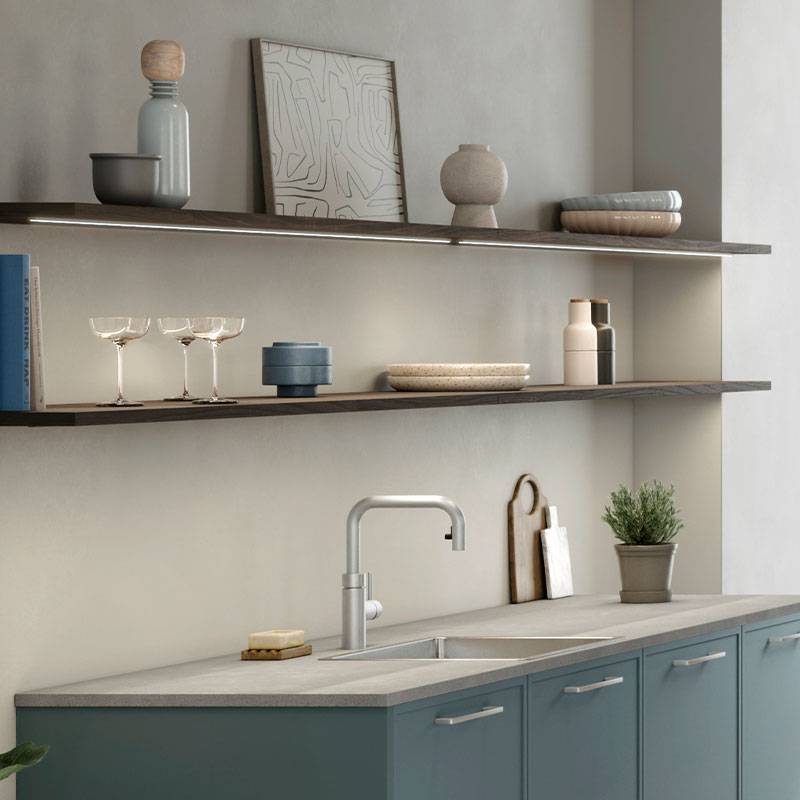
In a kitchen without wall cabinets, there is no space for under-cabinet lights. In this case, wall sconces or illuminated wall shelves serve this purpose.

Accent Lighting: Lighting for the Evening
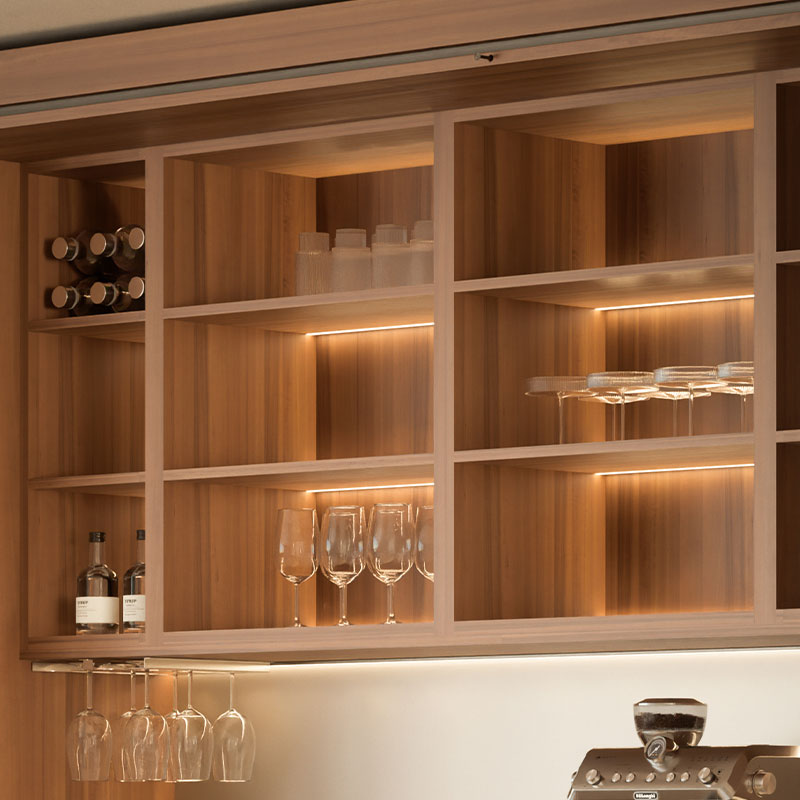
Accent lighting doesn’t simply illuminate—it sets the mood. Illuminated cove moldings add a subtle line of light to handle-less cabinet fronts. With Häcker, you can illuminate the cove moldings horizontally or vertically in whatever light color you prefer—from neutral white to warm white to cool white. The LED light strip can be installed either in the profile beneath the countertop, on the lower cove molding, or in the vertical profile.
Shelves and open compartments also become sources of light: cover panels and shelf tops are available with linear lighting, while shelves within cabinets feature indirect horizontal lighting. LED glass shelves and LED recessed spotlights in cabinet bottoms highlight small areas in the living and dining areas. Simply enjoy more comfort.
Light in the Cabinet: Glass Cabinet, Pull-Out, and Tall Cabinet
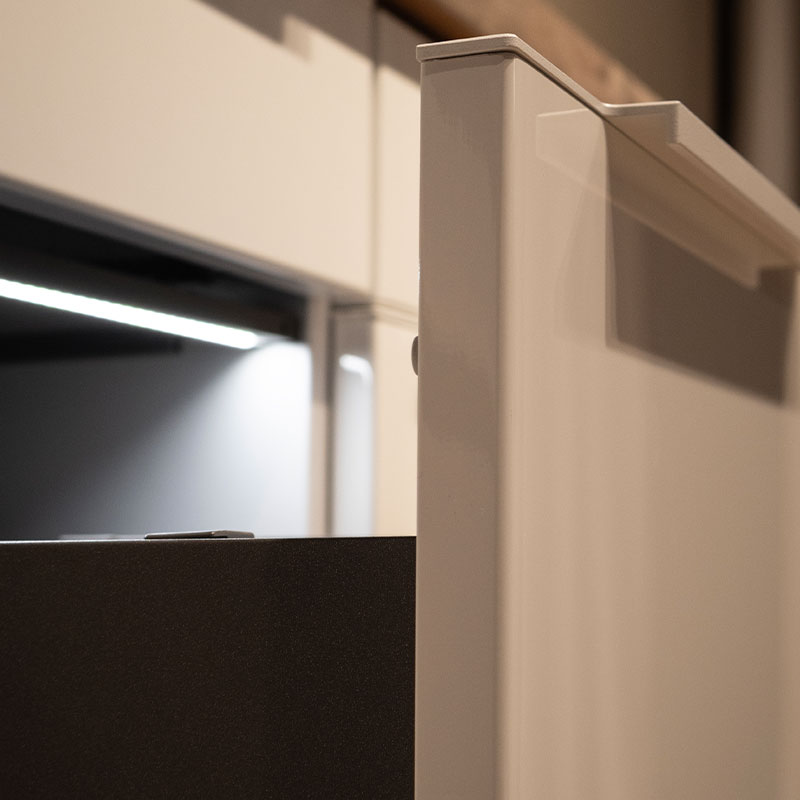
Light is needed inside cabinets, too: otherwise, tall cabinets and deep pull-outs remain in the dark. licht.de recommends planning for sufficient lighting so you can see inside shelves, cabinets, and drawers. According to the AMK, illuminated pull-outs help you see all the way to the farthest corner, even with soft lighting.
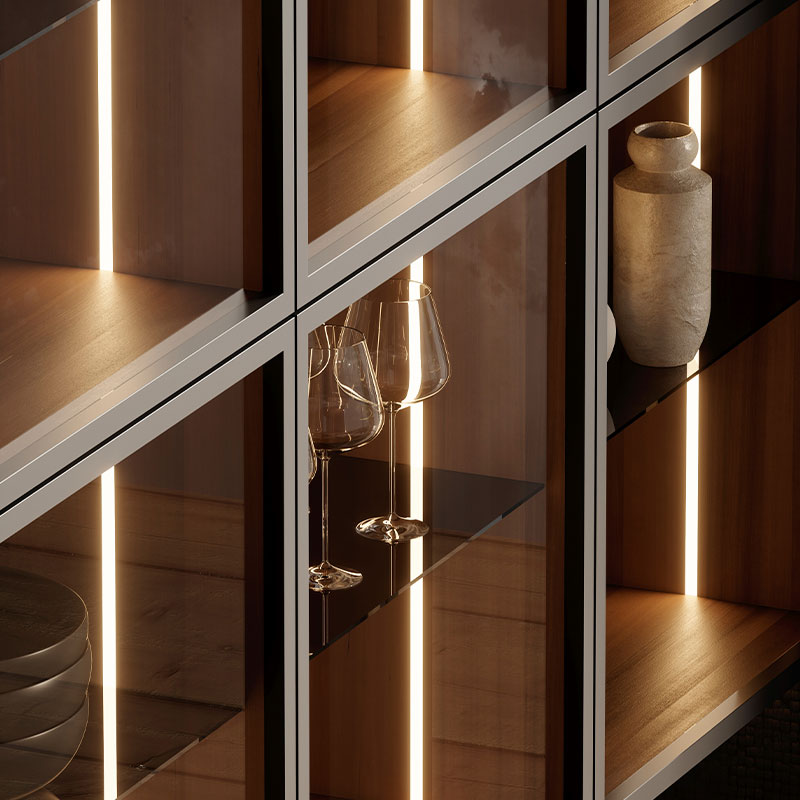
- Glass cabinets: Illuminated glass shelves and vertical light strips turn glasses, dishes, and favorite items into eye-catchers in the evening.
- Drawer lighting: An LED light mounted between the cabinet sides above the drawer provides neutral-white light inside the drawer. In the 2027 collection, it’s available in concept130 and systemat.
- Vertical lighting inside the cabinet: An LED light on the front edge of the cabinet side shines inward, illuminating upper, lower, and tall cabinets.
- Lighted drawers: The SlimLine Drawer in the systemat collection is optionally available with integrated lighting.

Dining Area Lighting: Light That Brings People Together
Above the dining table, the light should fall onto the table and cast a warm glow on people’s faces without causing glare. licht.de recommends hanging the pendant light so that its lower edge is about 60 centimeters above the tabletop; AMK suggests 60 to 70 centimeters—whether at the dining table or the counter. This ensures unobstructed eye contact with those across from you.
Dimmable lights are particularly worthwhile here. The light, which can be bright at breakfast, can be dimmed in the evening and set to a warmer tone. Height-adjustable pendant lights are ideal if the kitchen table is also used for working or playing. Simply share more joy.
Light color: Warm white, neutral white, or daylight white?
Light color is measured in Kelvin and has a significant impact on the atmosphere in a room. licht.de distinguishes between three groups:
- Warm white, 2,700 to 3,300 Kelvin: warm, slightly yellowish light
- Neutral white, 3,300 to 5,300 Kelvin: clear, neutral light
- Daylight white, over 5,300 Kelvin: cool light that, according to licht.de, appears sallow in indoor spaces with less than 500 lux
In the morning, the light can be brighter and cooler; in the evening, licht.de recommends warm light colors at a dimmed brightness. Fixtures with adjustable color temperature cover both needs: With many Häcker fixtures, you can adjust the light color via remote control, sensor, or smart home system. Häcker refers to the coolest setting on its cove lights as “cool white.”
Pay attention to color rendering
Another important metric is the color rendering index (Ra). It describes how faithfully a light source renders colors—from the color of your cabinet fronts to the vegetables on the cutting board. licht.de recommends a minimum of Ra 80 for the kitchen, preferably Ra 90 or higher.
Lumens and lux: the difference
Lumens indicate how much light a lamp emits; this value is listed in the product specifications. Lux indicates how much of that light reaches a surface: 1 lux corresponds to 1 lumen distributed evenly over one square meter. The recommendation of 500 to 650 lux therefore applies to the work surface, not to a single light fixture. How many lights you’ll need depends on the distance, beam angle, and surface area—you can discuss this with your retailer or electrician.
Controlling Lighting: From Switches to Smart Homes
A lighting concept is only as good as its controls. If everything is controlled by a single switch, there’s only one setting for all occasions. With Häcker, the integrated lighting can be controlled in three levels:
- on and off via the home’s electrical system, with a fixed light color
- via remote control or sensor, with adjustable color temperature
- via the smart home system or remote control, also with adjustable color temperature
This is powered by a modular control system. Its components are plug-in and can be expanded; with a mounting height of 15.8 millimeters, it fits between the upper cabinet and the wall. Thanks to Matter technology, you can control the lighting via an app or remote control; alternatively, a solution without an internet connection is available. The SlightLift wall cabinet also combines sliding and folding mechanisms with lighting control.
Tip: Decide early on which areas should be controllable separately—such as general lighting, task lighting, and the dining area. Then you can switch the lighting from cooking mode to evening mode without having to turn each light on or off individually.

Lighting Design for Unique Kitchens
Open-Concept Kitchen and Living Area
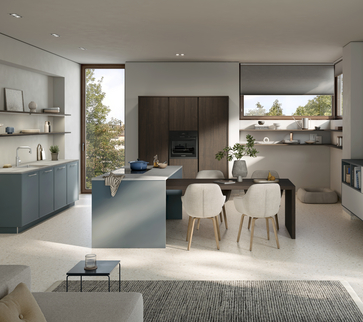
In an open-concept kitchen, cooking, dining, and living come together in a single space. Plan the zones so they can be controlled separately: the cooking area with bright, neutral white lighting; the dining area with warm, dimmable lighting; and the living area with indirect lighting. When only the accent lighting in niches, shelves, and baseboards is on in the evening, the work area recedes into the background and the kitchen becomes part of the living space. According to licht.de, light sources at different heights divide a large room into interconnected yet separate areas.
Kitchen Island and Counter
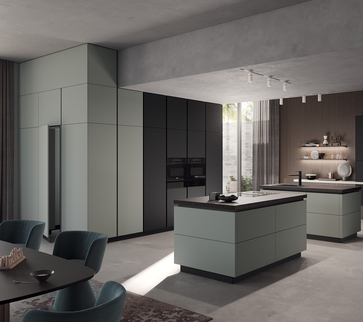
Open-concept kitchens are often separated from the living area by a counter. For dining counters, licht.de recommends several small pendant lights, chosen to match the size and shape of the space, with the bottom edge positioned about 60 centimeters above the countertop. If you cook or wash dishes at the island, the countertop there needs additional bright task lighting from above. Our guides on kitchen islands and kitchen counters show you how to plan your island and counter.
Kitchen with dark or bold colors
How bright a kitchen appears also depends on its surfaces. According to licht.de, the darker and more intense a color is, the more light it absorbs. White walls reflect up to 85 percent of the light, while light-colored wood paneling reflects up to 50 percent. Therefore, in a kitchen with dark cabinet fronts or bold colors, plan for ample lighting and use accent lighting to highlight the color. You can find ideas for colorful kitchens in our article on colorful kitchens.
Kitchen Under the Sloped Ceiling
Ceiling mounting is often limited under a sloped roof. In this case, adjustable spotlights, wall sconces, and lighting under upper cabinets and shelves can help. In this situation, plan the lighting in conjunction with the furniture layout, as the positions are interdependent.
Small Kitchen
In a small kitchen, every bit of space counts. Lighting integrated into upper cabinets, crown molding, and shelves doesn't take up any extra space and directs light exactly where you're working.
Avoiding Common Mistakes in Kitchen Lighting
Some lighting mistakes don’t become apparent until the kitchen is finished. By keeping these points in mind, you can avoid them right from the planning stage:
- Only one light fixture in the center of the room: It’s not enough for general lighting, and according to licht.de, a single light from above makes the walls appear closer. Distribute several light fixtures or downlights across the ceiling.
- Light from behind: If the light comes from behind you, you’ll be working in your own shadow. Task lighting should be positioned directly above the countertop.
- Glare from under-cabinet lights: Choose fixtures that are shielded toward the front so you don’t look directly into the light source.
- Everything on one switch: Without separately controllable zones, you’ll only have “bright” or “dim.” Plan general lighting, task lighting, and dining area lighting separately.
- Pendant light at the wrong height: Aim for about 60 centimeters between the tabletop and the light fixture. This way, the light won’t be glaring, and eye contact with the person across from you remains unobstructed.
- Cool light in the evening: For the dining area in the evening, licht.de recommends warm light colors at a dimmed brightness.
- Forgotten color rendering: Under lights with a low Ra value, cabinet fronts and food appear different than they do in daylight. Make sure the Ra is at least 80.

Checklist for Your Lighting Design
These questions should be clarified before the electrician arrives:
- Have the zones been defined—cooking, food prep, dishwashing, dining, and living?
- Where does natural light enter, and which areas remain dark even during the day?
- Is the general lighting distributed across multiple fixtures?
- Does each work surface have its own lighting that doesn’t cause glare?
- Which areas should have separate switches and be dimmable?
- Is the light color appropriate for each zone, and do the fixtures have a CRI of at least 80?
- Which lights are integrated into the furniture, and how should they be controlled?
- Are the locations of outlets and switches coordinated with the furniture layout?
- Do the lights bear certification marks such as the VDE, ENEC, or GS marks, and are the lights mounted on furniture suitable for installation on combustible surfaces?
Conclusion: Think of light in terms of layers
Good kitchen lighting isn’t just a single product—it’s a combination of elements: general lighting for the room, task lighting where you’re chopping, accent lighting for the evening, and a light above the table that brings people together. Plan your wiring, switches, and controls early on, and make as much of the lighting dimmable as possible.
Our article on cozy kitchens shows just how well light, colors, and materials can work together to create a warm atmosphere. And if you’d like to plan your lighting concept in detail: Use the dealer locator to find a Häcker specialty dealer near you who can help you plan your lighting along with your kitchen.
Frequently Asked Questions About Kitchen Lighting
How much light does the kitchen countertop need?
licht.de recommends 500 to 650 lux as the ideal illuminance for the countertop. The light should fall directly on the surface without causing glare or casting harsh shadows. Under-cabinet lights beneath the upper cabinets or illuminated shelves direct the light exactly where it’s needed.
What light color works best in the kitchen?
That depends on the area and the time of day. licht.de recommends cooler light colors where concentration is needed, and warm light colors at a dimmed brightness for the evening. Fixtures with adjustable color temperature cover both needs. For natural color rendering, light sources should have a CRI of at least 80.
How high should the pendant light hang above the dining table?
licht.de recommends about 60 centimeters between the tabletop and the bottom edge of the light fixture; AMK suggests 60 to 70 centimeters. This ensures the light doesn’t cause glare and allows for unobstructed eye contact with those across the table.
What types of lights does Häcker integrate into the kitchen cabinets?
Häcker’s lighting solutions include illuminated cove lighting, LED recessed lights in the bottoms of upper cabinets, countertop and shelf surfaces with linear lighting, illuminated glass cabinets, and pull-out lighting. A specialist retailer can help you determine which of these are best suited for your kitchen.
Can the kitchen lighting be controlled via a smart home system?
Häcker offers a dedicated control system for this: The integrated lighting can be switched on and off via the smart home system or a remote control, with adjustable color temperature. Which control options are available for your kitchen also depends on the outlet layout, so this topic should be addressed early in the planning discussion.